
Results of the 2026 Emerging Scholar Research Grants Competition
By making a significant investment in the advancement of emerging scholars, CCS aims to strengthen the future of the cancer research ecosystem in Canada. This opportunity is designed to support the establishment and advancement of promising early career investigators (ECR) from across Canada, with a focused commitment to undertaking cancer research. Through the CCS Emerging Scholar Research Grants, early career investigators will develop their independent cancer research programs in Canada and pursue important scientific advances of the highest quality and potential for impact across the 4 pillars of health research (biomedical; clinical; health services; and social, cultural, environmental & population health).
We are pleased to announce the results of the 2026 Emerging Scholar Research Grants competitions.

Expert Review Process
54 letters of intent (LOI) were received and 37 were invited to submit a full application after being reviewed across 7 expert review committees comprised of scientific experts and patient/survivor/caregivers with lived experience. 34 full applications were received, 33 were reviewed and 17 have been approved for funding – corresponding to a 32% success rate from the LOI stage and 52% at the full application stage. These projects total over $9.6 million in funding over the full term of these grants.
The 7 review panels were divided into the following thematic areas:
- Mechanisms of risk, initiation, and progression
- Molecular biomarkers
- Imaging & technology
- Therapeutics
- Immunotherapy
- Prevention & Supportive Care
- Health Services & Policy
View the Recipients of the 2026 Emerging Scholar Research Grants

Pillar 1

Pillar 2
CCS is proud to support 6 investigators, through 6 new grants, advancing clinical cancer research.
Pillar 3 & Pillar 4
Patient Engagement in Research
Engaging people affected by cancer and other community members in research and funding decisions is central to CCS’s research funding approach. Here’s how our grantees are engaging with people affected by cancer in their research:
No one understands what’s needed from a cancer test better than the people who have faced the disease themselves. That’s why we partner closely with patients, survivors and caregivers: they help shape the research so it answers real needs and they remind us every day why this work matters so much.
— Alexandre Pellan Cheng, Developing ultrasensitive liquid biopsies for lung cancer
Centre de recherche du CHUM, Montreal, QC
One of the most important lessons I have learned as an emerging cancer research scholar is that research is most likely to improve the lives of patients when it is shaped by the people it is meant to serve. This is why we partner with young people with cancer and their families throughout all phases of our research – to ensure we are asking the right questions and co-creating solutions that best meet their needs.
— Perri Tutelman, Helping young people with cancer express their wishes for future care
University of Calgary, Calgary, AB
This project was born out of a workshop where we asked patients and clinicians what they’d most want AI to help with. People affected by cancer have given us instrumental feedback at every stage, including big design decisions our team wouldn’t have arrived at on our own. Their involvement isn’t a formality; it’s what keeps the work grounded in what patients actually need.
— John-Jose Nunez, An AI tool to help people find the cancer care they need
BC Cancer, part of the Provincial Health Services Authority, Vancouver, BC
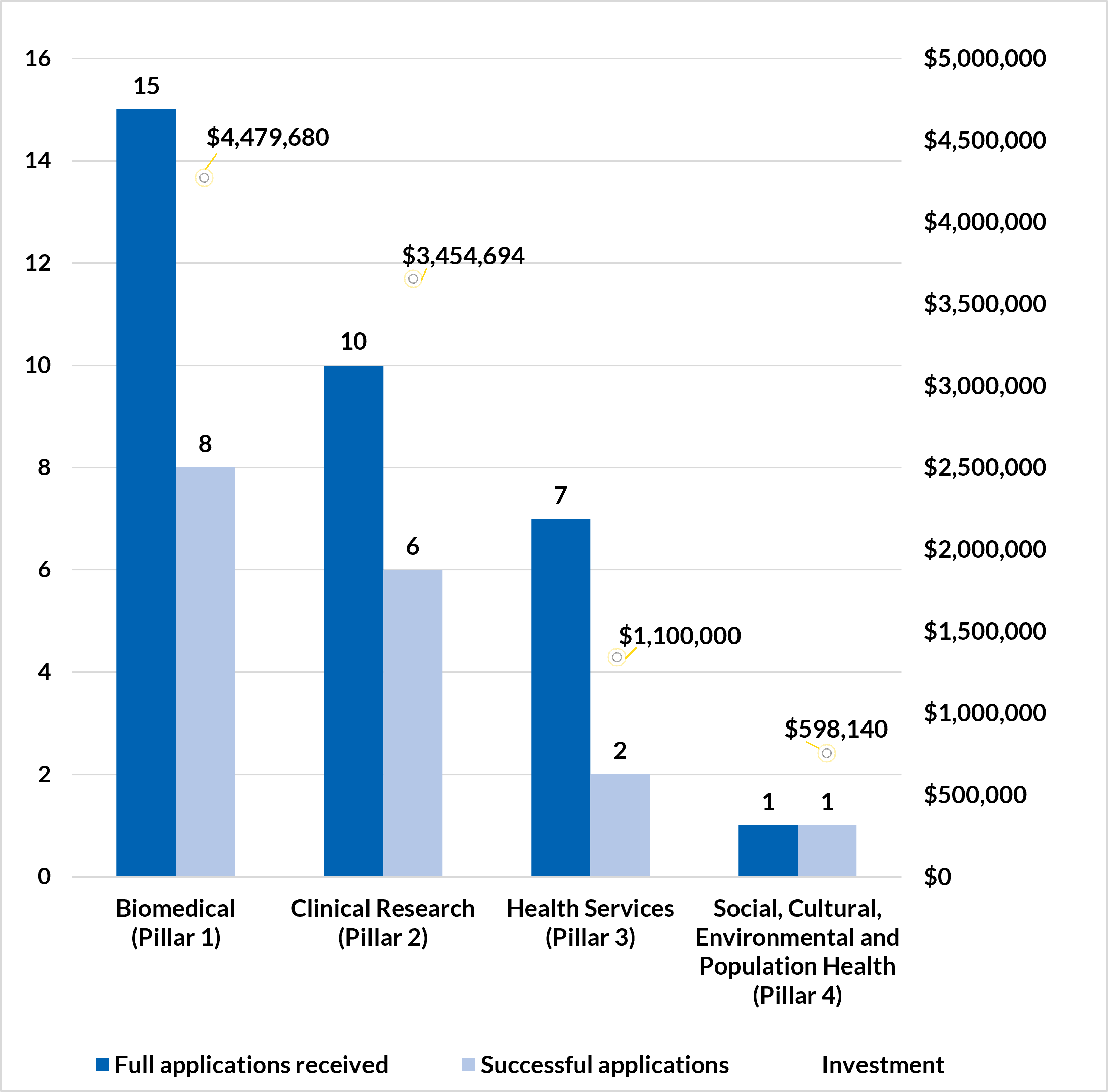
Investment by research area
Investment by cancer site

Results by province
